2026 · Field notesAbout 13 min readNovus Stream Solutions
Offer positioning for small teams: clarity that wins without big ad spend
How to position offers so buyers understand outcomes quickly and your team can sell consistently.
Contents
- 1.Overview
- 2.Message architecture that survives scale
- 3.Positioning maintenance
- 4.Testing positioning before you commit to it
- 5.Signs your positioning is drifting
- 6.Competitive positioning without obsessing over competitors
- 7.Positioning for different buyer journey stages
- 8.Specificity is the small-team advantage
- 9.The one-sentence test
- 10.Customer language beats clever copy
- 11.The boundary of what you are not
- 12.Positioning is a hypothesis, not a monument
- 13.Consistency across every touchpoint
Overview
Positioning is where growth either compounds or fragments. If prospects cannot explain your offer in one sentence, your sales process pays the tax with longer cycles and lower trust.
Small teams win by being specific: who it is for, what pain it solves, and how value is measured. Broad claims attract broad objections.
Message architecture that survives scale
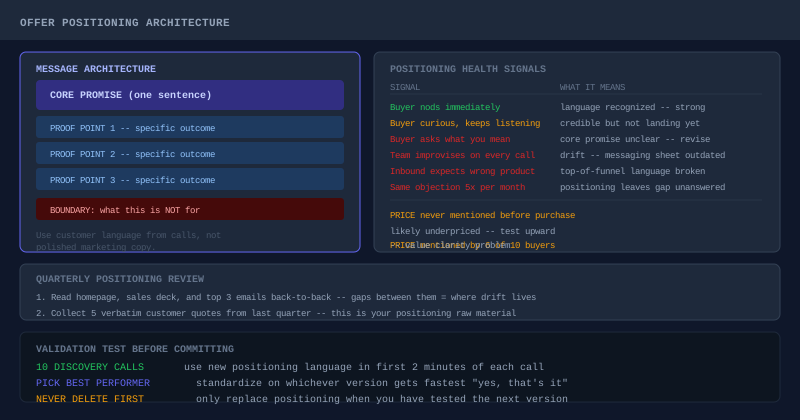
Define one core promise, three proof points, and one clear boundary of what your offer is not. That boundary is critical; it protects delivery quality and support bandwidth.
Use customer language from calls and tickets directly. Founders often over-polish copy and accidentally remove the words buyers actually use to decide.
Positioning maintenance
Review quarterly with real call transcripts. If your team improvises different explanations per channel, update your messaging sheet and retrain immediately.
Positioning is not a one-time copywriting exercise — it is a living hypothesis about who your buyer is and what they need to hear. As your product evolves, as you learn more about your best customers, and as the market around you shifts, the language that resonates changes too. A positioning statement that was accurate six months ago may now attract the wrong audience or fail to emphasize the capabilities that have become your strongest differentiators. Treat positioning review as a scheduled operating task, not a project you revisit only when results are clearly suffering.
The most useful artifact from a positioning review is not a new tagline — it is a clarified customer archetype. Document who your best three clients from the last quarter were, what they said during discovery, what made them close, and what outcome they described when they were most satisfied with your work. That language is your positioning raw material. The best copy always comes from inside the customer's own experience rather than from a marketing team working in isolation from real conversations.
- Collect five verbatim customer quotes from the last quarter — these are your positioning raw material.
- Check that your homepage, sales deck, and email templates use consistent language for the core promise.
- Identify one phrase or claim you are currently leading with that your best clients never actually say.
Testing positioning before you commit to it
The fastest way to validate positioning is to say it out loud to a prospective customer and watch their face. If they nod immediately, you are using language they recognize from their own problem. If they look slightly confused but keep listening, you are using language that sounds credible but does not land. If they interrupt with a clarifying question, your core promise is unclear. Each of those three reactions tells you something specific about where to revise.
Before investing in ad creative, landing pages, or sales training built on a positioning statement, run ten discovery calls where you deliberately use the new language in the first two minutes. Track which version of the core promise generates the fastest "yes, that is what I need" response. That version becomes your canonical message. Do not average the responses — pick the best performer and standardize on it.
- Run five conversations using the new positioning before committing to any production assets.
- Record calls (with permission) and review the exact moment the prospect either engages or disengages.
- Update positioning only when you have a direct replacement — never delete before you have tested the next version.
Signs your positioning is drifting
Positioning drift is invisible from the inside. The clearest external signal is when different team members explain the product differently to prospects — each improvisation is evidence that the official positioning no longer feels accurate or useful. A second signal is when the objections you hear on sales calls start clustering around the same misunderstanding. If five prospects in a month all ask the same question that your positioning should have answered, the positioning has not answered it.
A third signal is when inbound leads arrive expecting something your product does not do. This means your top-of-funnel language is attracting the wrong intent. Run a positioning audit: read your homepage, your sales deck, and your top three marketing emails back to back and ask whether a new prospect would accurately understand what you sell, who it is for, and what they give up by not buying. Gaps between those three materials are where drift lives.
Competitive positioning without obsessing over competitors
The temptation in positioning is to orient your message primarily around what makes you different from your three most obvious competitors. This approach produces positioning that is clear only to people who already know the category well — it relies on the prospect being familiar enough with the alternatives to understand why your differentiation matters. Buyers who are early in their search process or new to the category have not formed the comparison frame yet, which means competitor-relative positioning lands as noise rather than clarity.
Position against the buyer's current situation first and against competitors second. "Better than X" only resonates if the prospect already knows X. "Solves the problem of Y without requiring Z" resonates with anyone who has the problem and has experienced the constraint. The competitive differentiation can be the third message the prospect hears, after they have understood what you solve and why you are credible. This sequence works because it meets the buyer where they are rather than where your competitive analysis begins.
Positioning for different buyer journey stages
The positioning language that works for a prospect who is actively comparing vendors is different from the language that works for someone who has just realized they have a problem. Early-stage buyers need problem framing and category education. Mid-stage buyers need social proof and specific outcome evidence. Late-stage buyers need differentiation and risk removal. One positioning statement rarely serves all three stages equally well.
Map your content and outreach language to the stage you are trying to reach. Your blog and top-of-funnel content should speak to early-stage buyers in the language of the problem — before they are ready to evaluate solutions. Your case studies and comparison pages should speak to mid-stage buyers in the language of outcomes and proof. Your sales conversations and proposal language should speak to late-stage buyers in the language of specifics and guarantees. When all of your messaging sounds the same regardless of stage, you are leaving conversion on the table at each transition point.
Specificity is the small-team advantage
A small team cannot out-spend larger competitors on awareness, but it can out-position them through specificity, which is a genuine and underused advantage. Broad positioning — appealing to everyone, claiming to solve many problems — is what large companies with large budgets can afford, because they can spend their way to awareness despite the dilution. A small team that tries the same broad approach simply gets lost, because broad claims attract broad objections and a small voice making a general claim is indistinguishable from the noise. Specificity is how a small team becomes the obvious choice for a particular buyer rather than a forgettable option for everyone.
The mechanics of specificity are naming exactly who the offer is for, exactly what pain it solves, and exactly how the value is measured. The more precisely you can describe your ideal buyer and their specific problem, the more strongly that buyer recognizes themselves in your positioning and the less they object, because the offer was clearly built for them. A buyer who reads a specific positioning thinks "this is for me"; a buyer who reads a broad one thinks "this might be for me, but I am not sure." For a small team, the certainty of the first reaction in a narrow audience beats the vagueness of the second in a broad one, because conversion comes from recognition, and recognition comes from specificity. Narrowing the positioning is counterintuitively how a small team wins, by being unmistakably right for someone rather than vaguely relevant to everyone.
The one-sentence test
The single most useful diagnostic for positioning is whether a prospect can explain your offer in one sentence after encountering it, because if they cannot, your sales process pays the tax in longer cycles, more confusion, and lower trust. Positioning that requires a paragraph to convey, or that leaves the prospect able to describe only vaguely what you do, has failed its primary job, which is to make the offer immediately understandable. The one-sentence test is unforgiving and clarifying: state your positioning to someone unfamiliar and ask them to repeat back what you do, and the gap between what you said and what they understood is exactly your positioning problem.
When a prospect can crisply explain your offer in their own words, several good things follow: they can advocate for it internally to other decision-makers, they can recommend it to others, and they evaluate it efficiently because they understand it. When they cannot, every one of those breaks down — they cannot sell it internally, cannot refer it, and stall in evaluation because they are unsure what they would be buying. The one-sentence clarity is therefore not a copywriting nicety but the foundation of an efficient sales process and organic word-of-mouth. Achieving it usually means cutting rather than adding — removing the qualifications and the comprehensiveness that dilute the core message until a single clear sentence remains. If you cannot pass the one-sentence test, no amount of downstream sales effort fully compensates, which is why it is the test worth optimizing for first.
Customer language beats clever copy
A persistent positioning mistake is over-polishing the language until it sounds impressive but no longer matches the words buyers actually use, which quietly reduces resonance. Founders, wanting their copy to sound sophisticated, tend to refine the rough, specific language of real customer problems into smooth, professional phrasing that loses the exact words buyers say in their own heads. But buyers recognize and respond to their own language, not to elevated marketing prose, so the polishing that feels like improvement often removes the very phrases that would have made a prospect think "yes, that is exactly my problem." The clever version impresses; the customer's own version converts.
The remedy is to source positioning language directly from customer conversations — sales calls, support tickets, the words prospects use to describe their problem — and to resist the urge to refine those words into something more polished. The phrases that come up repeatedly in real conversations are positioning gold, because they are the language the buyer already uses to think about the problem, and reflecting that language back creates immediate recognition. Collecting verbatim customer quotes and building positioning from them, rather than from a marketing team's sense of how things should sound, keeps the positioning grounded in the buyer's reality. The discipline is to value resonance over polish, which means sometimes keeping language that sounds less sophisticated because it is the language that actually lands. Customer words convert; clever words impress, and conversion is the goal.
The boundary of what you are not
A frequently-omitted but crucial element of strong positioning is an explicit boundary — a clear statement of what your offer is not and who it is not for — which protects both your positioning clarity and your delivery quality. The instinct is to avoid saying what you do not do, for fear of turning away potential buyers, but a positioning without boundaries is a positioning that invites mismatched buyers, scope confusion, and the support burden of customers who expected something you never offered. Stating the boundary clearly disqualifies the wrong buyers before they become a problem and sharpens the positioning for the right ones, who appreciate the clarity about exactly what they are getting.
The boundary also protects your operation's capacity, which for a small team is a real constraint. Buyers who arrive expecting things outside your boundary consume support, generate dissatisfaction, and erode delivery quality for the buyers you are actually built to serve. A clear "this is what we do not do" filters those mismatches out before they enter, preserving your bandwidth for the well-fit customers. Far from costing you sales, the boundary improves the quality of the buyers you attract by ensuring they are the ones your offer genuinely fits. The confidence to state what you are not is a sign of positioning maturity — it signals that you know your strength precisely enough to define its edges, which is more attractive to the right buyer than a vague willingness to be everything to everyone. The boundary is part of the positioning, not an exception to it.
Positioning is a hypothesis, not a monument
Positioning should be treated as a living hypothesis about who your buyer is and what they need to hear, continually tested against reality, rather than a monument you carve once and defend. As your product evolves, as you learn which customers are your best fit, and as the market shifts, the language that resonates changes, and positioning that was accurate six months ago can drift into attracting the wrong audience or underselling your real strengths. Treating positioning as a hypothesis means scheduling regular review against real customer conversations, and updating it when the evidence shows it no longer matches who you serve and what they value.
The most useful output of a positioning review is not a new tagline but a clarified picture of your best customers — who they are, why they bought, and how they describe the value they got. That clarified archetype is the raw material for positioning that resonates, because it is built from the reality of who actually succeeds with your offer rather than from a strategic guess. Reviewing positioning quarterly against real call transcripts and best-customer patterns keeps it aligned with the truth as the truth changes, which a one-time positioning exercise cannot. The discipline of treating positioning as a hypothesis to be tested and revised, rather than a finished statement, is what keeps it accurate over time, and accurate positioning is what keeps the whole funnel efficient. Positioning that is reviewed and updated stays sharp; positioning that is set and forgotten slowly stops matching the business it is supposed to describe.
Consistency across every touchpoint
Positioning only works if it is consistent across every place a prospect encounters it, because inconsistency between the homepage, the sales deck, the emails, and the actual sales conversation signals an operation that is unsure of itself. When different team members and different materials describe the offer differently, the prospect cannot form the clear single understanding that positioning is meant to produce, and the resulting confusion reads as a lack of conviction. Consistency is not about identical copy everywhere, which would feel robotic, but about every touchpoint conveying the same core promise, the same buyer, and the same boundary, so the prospect builds one coherent picture rather than reconciling several.
Achieving this consistency requires treating positioning as a shared operating standard rather than individual interpretation, which means documenting the core promise, proof points, and boundary, and aligning every customer-facing surface to them. The clearest sign of positioning drift is when team members improvise different explanations on different channels, each variation evidence that the official positioning is not being held consistently. The fix is to maintain a single positioning reference and to check that the homepage, the sales materials, and the email templates all use consistent language for the core promise. For a small team especially, where the same few people touch every channel, the discipline of consistency is achievable and high-leverage: it ensures that the specific, tested, customer-grounded positioning you worked to develop is actually what every prospect encounters, rather than being diluted into a different version at each touchpoint. Consistency is what lets the positioning compound rather than fragment.
Frequently asked questions
Quick answers to common questions about this topic.
What is offer positioning and why does it matter?
Positioning is making crystal clear who your offer is for and what problem it solves. A sharply positioned offer needs less ad spend because the right people immediately recognize it is for them.
How do small teams compete without big budgets?
With clarity and focus, not volume. A specific offer to a specific audience converts better than broad messaging, so a tiny team can win a niche it speaks to precisely.