2026 · Field notesAbout 14 min readNovus Stream Solutions
Operator content calendar that converts: plan once, execute weekly
A practical planning model for business content that drives qualified demand, not just impressions.
Contents
- 1.Overview
- 2.A weekly publishing structure
- 3.Content operations hygiene
- 4.Planning content themes around business cycles
- 5.Auditing existing content before publishing more
- 6.Getting your team to contribute content without creating chaos
- 7.Measuring content against the funnel, not the feed
- 8.Distribution strategy for content that earns its investment
- 9.Publishing frequency is the wrong goal
- 10.Map content to the buying stages
- 11.One clear action per piece
- 12.Content is a maintained asset, not a publishing event
- 13.Reverse-engineer the calendar from business events
Overview
Content calendars fail when they optimize for publishing frequency instead of buyer progression. The right calendar maps topics to buying stages and clear next actions.
Operators should plan around themes tied to offers and support load, not around whatever seems trendy on a given day.
A weekly publishing structure
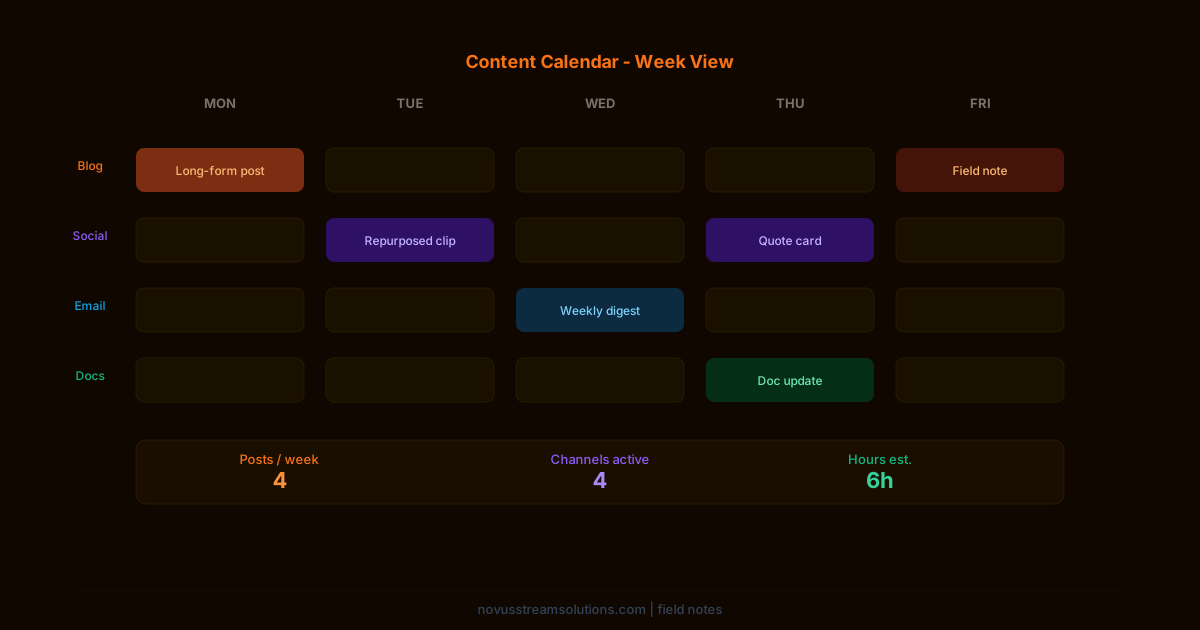
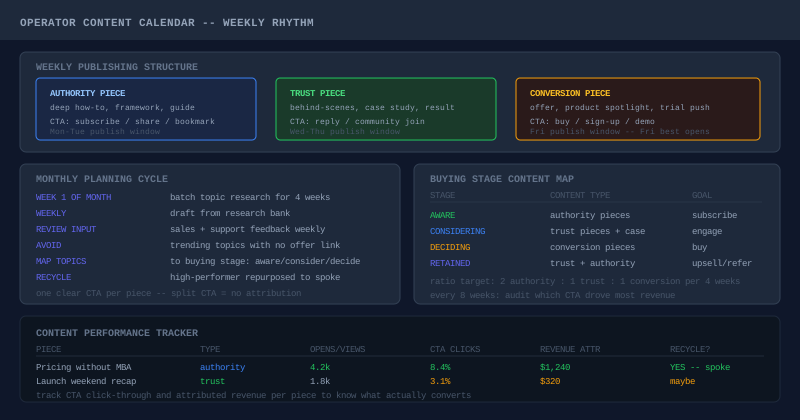
Use a simple rhythm: one authority piece, one trust piece, one conversion piece. Keep each with one clear CTA so analytics can attribute performance cleanly.
Batch topic research monthly, draft weekly, and review with sales/support feedback to avoid disconnected messaging. Batch the production assets too — a consistent thumbnail or cover, composed quickly in the editor at bgremover.novusstreamsolutions.com/editor, keeps the feed cohesive without becoming the bottleneck.
Content operations hygiene
Keep a content inventory with last update date and current CTA destination. Outdated content with stale offers quietly leaks revenue.
Content operations hygiene is the unglamorous work that separates content programs that compound from ones that plateau. Every piece of content you publish is an ongoing commitment: it may rank, drive traffic, and be read by prospects for years after publication. That longevity is an asset when the content is accurate and the CTA works. It becomes a liability when the offer has changed, the product has evolved, or the linked page no longer exists. A quarterly audit of your top 20 pages by traffic takes two hours and consistently surfaces problems that would otherwise quietly drain conversion for months.
The most common hygiene failure is internal links that point to deprecated pages. When a product is retired, a pricing page is updated, or a landing page is rebuilt, internal links in older content often go unupdated. Visitors following those links reach dead ends or irrelevant destinations and attribute the friction to the brand rather than to a maintenance gap. A broken internal link experience is not neutral — it signals disorganization to the visitor and wastes the trust the content built getting them to click.
- Audit your top 20 traffic pages quarterly: check every CTA, every internal link, and every offer referenced.
- Assign a "content owner" to each major topic cluster — one person who is responsible for keeping it current.
- When retiring a product or offer, create a task to update all content that references it before the change goes live.
Planning content themes around business cycles
The best content calendars are not built around trending topics — they are built around the business events that create natural buying moments. For a service business, these events include the beginning of a budget cycle, a common seasonal challenge in your client's industry, or a regulatory or market change that creates urgency. Map your editorial themes to those moments and your content arrives when prospects are already in problem-solving mode.
Work backward from your business objectives: if a new service offering launches in October, your September content should be addressing the problem that service solves. If your highest-margin clients tend to close deals in Q1, your Q4 content should be building the authority and trust that makes those conversations easier. A calendar that is reverse-engineered from your sales timeline will always outperform one built around what feels interesting to write about this week.
- Map your top three revenue events to content themes in the six weeks preceding them.
- Identify two recurring seasonal challenges in your client base and address them annually.
- Review your editorial plan quarterly against your sales pipeline to check for alignment gaps.
Auditing existing content before publishing more
Most operators underestimate how much content they already have and overestimate how much new content they need. Before planning a new month of publishing, run a quick audit: list every piece of content published in the last 12 months, note its CTA, its traffic trend, and whether the CTA destination is still accurate. You will typically find that 20 to 30 percent of your content is driving real results, 40 percent is neutral, and 30 percent has a broken CTA, outdated offer, or declining traffic signal that should be addressed before you add more volume.
Updating high-potential existing pieces almost always produces faster results than writing new content from scratch. A piece that already ranks on page two for a relevant term can reach page one with a substantive update; a brand-new piece starts from zero. Prioritize updates to pieces with existing search impressions, existing backlinks, or strong historical traffic that has since declined. The compounding effect of a maintained content library beats the diminishing returns of relentless new production.
Getting your team to contribute content without creating chaos
Content contribution from non-writers on a small team is one of the highest-leverage activities available — subject matter experts produce more credible and more specific content than generalist writers working from a brief. The obstacle is usually process, not willingness. When contributing feels complicated — unclear brief, unclear timeline, unclear what happens after submission — most people default to not contributing rather than asking for clarification. Reduce the friction and the contributions will follow.
A simple contribution framework includes a brief template that takes five minutes to fill out, a clear editor who handles the translation from raw input to published piece, and a defined turnaround time so contributors know when to expect their piece to appear. The brief template asks three things: who is this for, what is the one thing they should take away, and what is an example or story that illustrates it? A team member who can answer those three questions has given an editor enough to build a publishable piece, even if the raw input needs significant shaping.
Measuring content against the funnel, not the feed
The metrics that tell you whether content is working are not the engagement numbers that platforms surface — impressions, likes, shares — but the funnel metrics that connect content to business outcomes. A piece can generate impressive engagement while driving no qualified demand, and another can generate modest engagement while reliably producing inquiries from well-fit prospects; the engagement numbers would rank these backwards. Measuring content against the funnel means tracking whether pieces drive the next action they were designed to drive — the subscription, the inquiry, the progression to the next stage — rather than whether they performed well on a platform's own vanity metrics, which are optimized to keep you publishing, not to grow your business.
This funnel-oriented measurement is what lets you distinguish content that earns its production cost from content that merely accumulates engagement, and it depends on the single-action discipline that makes each piece's contribution attributable. When a piece has one clear call to action, you can measure whether it drove that action and judge the piece on its actual job; when a piece is measured on engagement, you learn whether the platform liked it, which is a different and less useful question. Building the habit of asking, for each piece, whether it moved prospects toward a business outcome rather than whether it performed on the feed is what keeps the content program connected to the funnel it is supposed to feed. The feed rewards content that keeps you on the platform; the funnel rewards content that grows the business, and measuring against the latter is what ensures the content investment produces returns the business can actually use.
Distribution strategy for content that earns its investment
Content without distribution is a private document. The investment in producing a piece is only recovered when enough of the right people read it to generate the awareness, trust, or conversion it was designed to produce. Most small teams publish and then rely on organic discovery to do the distribution work — which means most pieces are read far fewer times than the production investment justified. Build a repeatable distribution checklist that runs alongside every publication: email list announcement, relevant community sharing, internal link from existing high-traffic pages, and a social teaser for discovery.
Distribution compounds when pieces reference each other. A new article that links to two related older articles increases the traffic to the older pieces while benefiting from their existing authority. Over time, a well-linked content library behaves like a web rather than a collection of independent pages — readers and search engines can navigate through it, which improves engagement and rankings simultaneously. This internal linking practice costs no additional production time; it just requires the habit of checking before publication whether there is an existing piece worth pointing to.
Publishing frequency is the wrong goal
The most common way content calendars fail is by optimizing for publishing frequency instead of buyer progression, which produces a steady stream of content that fills the schedule without moving anyone toward a purchase. Frequency feels like productivity — you published this many pieces this month — but the number of pieces is not the outcome that matters; what matters is whether the content moves prospects through the stages of their buying decision toward a clear next action. A calendar built around hitting a publishing cadence will reliably produce content, but much of it will be disconnected from any business objective, optimized for the vanity of volume rather than the substance of conversion.
The right calendar maps topics to buying stages and explicit next actions, so that each piece has a job in advancing a prospect rather than just occupying a slot. This reframes the planning question from "what will we publish this week" to "what does a prospect at this stage need to hear, and what should they do next" — a question whose answers connect content to the funnel. Content planned this way may be less frequent than content planned for volume, but each piece earns its place by doing work that frequency-driven content does not. The discipline is to resist the pull of the publishing cadence as the goal and to hold buyer progression as the goal instead, because a smaller amount of content that moves prospects beats a larger amount that merely fills a schedule. Frequency is an input that feels like an output; progression is the output that actually matters.
Map content to the buying stages
Content works when it meets prospects where they are in their buying journey, which means a useful calendar deliberately covers the different stages rather than producing everything at one level. A prospect who has just realized they have a problem needs different content — problem framing, category education — than one who is comparing solutions, who needs proof and outcomes, or one who is ready to decide, who needs differentiation and risk removal. A calendar that maps topics to these stages ensures you are producing content for prospects throughout the journey rather than, as commonly happens, producing only the kind of content that comes naturally and leaving gaps where prospects at other stages drop off.
A practical rhythm that covers the stages is to balance authority content that builds credibility, trust content that provides proof, and conversion content that drives a specific action, ensuring each stage of the journey is served. This balance prevents the common failure where an operation produces abundant top-of-funnel awareness content but little that helps a prospect actually decide, or conversely floods conversion content at an audience that does not yet understand the problem. Mapping the calendar to the stages, and maintaining a deliberate mix across them, is what makes the content collectively move prospects from awareness through to purchase rather than serving only one part of the journey. The mix is the mechanism that turns individual pieces into a system that advances buyers, which is the entire point of a calendar built around progression rather than frequency.
One clear action per piece
A content piece that asks for several things, or nothing in particular, dilutes its ability to do any of them, which is why each piece should have one clear next action that the reader is meant to take. A single, specific call to action focuses the piece, makes its job unambiguous, and — practically — allows the analytics to attribute performance cleanly, because you can measure whether the piece drove the one action it was designed to drive. When a piece offers multiple competing actions, the reader's attention splits and the measurement blurs, so you can neither move the reader decisively nor learn cleanly what the piece accomplished. One piece, one action is the discipline that keeps content both effective and measurable.
The single-action discipline also forces clarity about the piece's purpose during planning. If you cannot name the one action a piece should drive, the piece does not yet have a clear job, and writing it will produce something unfocused. Deciding the call to action first — what should the reader do after reading this — clarifies what the piece needs to accomplish to earn that action, which improves the content itself. This connects to the stage mapping: the appropriate action differs by stage, with awareness content driving a soft next step and conversion content driving a purchase or inquiry, but in every case there should be exactly one. The combination of mapping content to stages and giving each piece one stage-appropriate action is what makes a content program a coherent system rather than a pile of pieces, because each piece both serves its stage and moves the reader toward the next, measurably.
Content is a maintained asset, not a publishing event
A piece of content is not finished when it is published; it is a standing asset that may rank, drive traffic, and be read by prospects for years, which means it carries an ongoing maintenance obligation that most operators neglect. The longevity that makes content valuable also makes it a liability when it goes stale: a piece that still ranks and draws traffic but references a retired product, an outdated offer, or a broken link is actively misleading the prospects it reaches and quietly leaking the trust it was built to create. Treating content as a maintained asset — with periodic audits of the top-traffic pieces to confirm their calls to action, internal links, and referenced offers are still accurate — is what keeps a content library compounding rather than decaying.
The highest-return content work is often updating existing high-potential pieces rather than writing new ones, because a piece that already has traffic, rankings, or backlinks starts from a position a new piece must spend months reaching. A maintained library, where strong older pieces are kept current and refreshed, behaves like an appreciating asset, while an unmaintained one accumulates stale pages that drag on conversion and credibility. The discipline of auditing and updating — checking the top pieces regularly, fixing broken links and outdated references, refreshing pieces with declining traffic that still have underlying value — is unglamorous compared to producing new content, but it produces faster results and protects the value already built. Content operations hygiene is what separates a content program that compounds over years from one that plateaus as its early wins quietly rot, and it is the maintenance mindset, not just the publishing mindset, that builds a durable content asset.
Reverse-engineer the calendar from business events
The strongest content calendars are not built around what is trending or interesting to write but around the business events that create natural buying moments, which is a fundamentally different planning input. For most businesses there are predictable moments when demand concentrates — the start of a budget cycle, a recurring seasonal challenge in the customer's world, a product launch, a period when the best customers tend to buy — and content timed to arrive just before those moments meets prospects when they are already in problem-solving mode. Mapping editorial themes to these business events, rather than to a content team's sense of interesting topics, is what makes content arrive when it can convert rather than when it merely fills the schedule.
Reverse-engineering the calendar from the sales timeline means working backward from objectives: if an offering launches in a given month, the content in the preceding weeks should be building awareness of the problem it solves; if the highest-value deals tend to close in a particular quarter, the prior quarter's content should be building the authority that makes those conversations easier. This sales-aligned planning consistently outperforms topic-driven planning because it ensures the content is doing business work at the moments business happens, rather than being disconnected from the funnel it is supposed to feed. The calendar reviewed quarterly against the actual sales pipeline, checked for alignment between what is being published and what the business needs in the coming weeks, stays connected to outcomes in a way a calendar built around interesting topics never does. Content timed to the business is content that converts; content timed to the editorial whim is content that merely exists.
Frequently asked questions
Quick answers to common questions about this topic.
How do I build a content calendar that actually converts?
Plan a batch of topics tied to real goals once, then execute weekly against that plan. Mapping each piece to an intent — attract, educate, or convert — keeps content purposeful rather than random.
Why plan content in batches?
Planning once and executing weekly removes the daily "what do I post" decision, which is where consistency usually breaks. A backlog keeps you publishing even on uninspired days.