2026 · Field notesAbout 13 min readNovus Stream Solutions
Ecommerce conversion lift without discounting margin into oblivion
Conversion improvements that increase revenue quality without defaulting to constant promos.
Contents
- 1.Overview
- 2.High-impact non-discount levers
- 3.Measure what matters
- 4.Trust signals that outperform discount cycles
- 5.Sequencing improvements for compounding lift
- 6.Mobile conversion considerations
- 7.Post-purchase experience as a repeat conversion lever
- 8.Why discounting becomes a trap
- 9.Clarity is the first conversion lever
- 10.Checkout friction is invisible margin
- 11.Trust signals at the moment of doubt
- 12.Conversion that respects margin
- 13.The economics of the second purchase
Overview
Discounts can rescue short-term weeks and quietly train your audience to wait. Sustainable ecommerce growth comes from conversion quality: clearer product understanding, stronger trust signals, and less checkout friction.
If your only conversion lever is price, your brand has no strategic moat yet. Work the fundamentals before promotions become your default operating mode.
High-impact non-discount levers
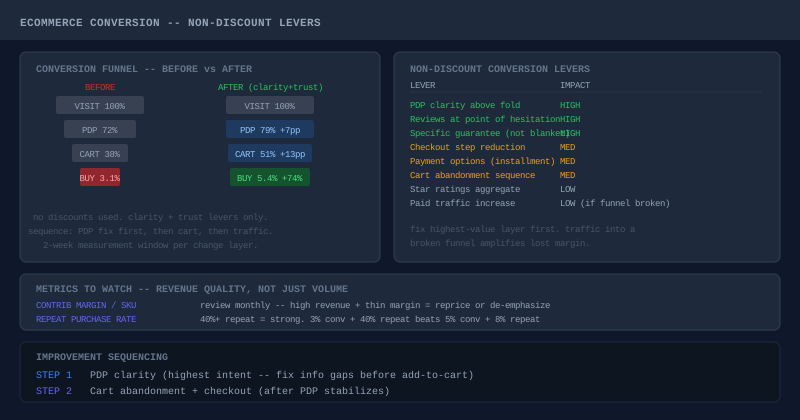
Improve PDP clarity first: benefits, sizing or fit details, shipping windows, and return expectations above the fold. Unknowns kill intent. Clean, consistent product images are part of that clarity — tools like bgremover.novusstreamsolutions.com/background-remover make it cheap to standardize a catalog without a studio.
Then optimize checkout sequence and payment options. Fewer fields and clearer progress indicators reduce abandonment without cutting gross margin.
Measure what matters
Track conversion alongside contribution margin and repeat purchase behavior. A conversion win that destroys margin quality is not a win.
The metrics that matter most in ecommerce are not the ones at the top of the funnel — they are the ones that describe what happens after the first purchase. Repeat purchase rate, days between orders for returning customers, and average order value on the second purchase are all stronger indicators of business health than first-purchase conversion rate. A store that converts 3 percent of visitors but has a 40 percent repeat rate is in a fundamentally stronger position than a store converting 5 percent with an 8 percent repeat rate, because the margin economics of repeat customers are dramatically better.
Build a contribution margin view for each product category, not just an overall revenue report. Knowing that one SKU drives 60 percent of revenue but only 20 percent of margin tells you something that an aggregate revenue dashboard cannot. Categories with high revenue but thin margins are candidates for price testing, bundle repackaging, or de-emphasis in your marketing mix. Categories with modest revenue and strong margins deserve more promotional attention. This level of product-level visibility is the difference between operating from data and operating from intuition.
- Calculate contribution margin per SKU monthly — not just total revenue.
- Set a repeat purchase rate target for your top three products and track it weekly.
- Flag any conversion optimization that improves rate but reduces average order value or margin.
Trust signals that outperform discount cycles
The most underused conversion lever in ecommerce is social proof at the point of hesitation — not at the top of the page, but adjacent to the add-to-cart button. Reviews that answer the specific objection a buyer is likely holding (fit, durability, shipping speed) convert better than aggregate star ratings because they speak to intent. Curate reviews that address your most common pre-purchase questions rather than displaying the most recent five.
Guarantees work similarly when they are specific. "30-day returns" is table stakes. "If the fit is wrong for any reason, we cover return shipping" removes a concrete objection. The specificity signals that you have thought about the buyer's experience rather than just offering a generic policy. Pair specific guarantees with a transparent FAQ that answers sizing, materials, and care in plain language, and you eliminate the information gaps that cause abandoned carts.
- Audit your PDP for the top three questions support receives and answer them above the fold.
- Replace generic star ratings with curated reviews that address fit, quality, and shipping expectations.
- Add one specific guarantee that removes the highest-friction objection — not a blanket policy.
Sequencing improvements for compounding lift
Conversion improvements compound when they are sequenced correctly. Start with product page clarity because that is where intent is highest — a visitor on a PDP is already interested. Fix the information gaps that cause them to leave before adding to cart. Once PDP conversion improves, move to cart abandonment: email sequences, on-site reminders, and simplified checkout. Only after those layers are working should you invest in top-of-funnel traffic improvements that send more visitors into a still-broken funnel.
Each layer of improvement requires a measurement window before moving to the next. Running changes simultaneously makes it impossible to attribute results. A two-week measurement window for PDP changes, followed by a two-week window for checkout changes, gives you a clear read on what is working. This deliberate pacing feels slow but produces data you can act on with confidence rather than guesses layered on top of each other.
Mobile conversion considerations
Mobile shoppers experience your store differently than desktop shoppers, and most ecommerce improvement frameworks are built on desktop behavior patterns. On mobile, above-the-fold space is smaller, image loading is slower, checkout form completion is more friction-intensive, and the buyer is more likely to be interrupted mid-session. A store that converts well on desktop may convert significantly worse on mobile for reasons that are independent of product appeal or pricing.
Audit your mobile experience specifically: load time on a mid-range phone with a typical data connection, the number of taps required to reach checkout from a product page, how the add-to-cart button behaves when the keyboard covers the screen on smaller devices, and whether your payment options include one-tap methods like Shop Pay or Apple Pay that remove typing from the checkout flow. Each of these friction points is measurable and addressable without changing your product or price, which is why mobile optimization belongs in the same conversation as any other conversion improvement program.
Post-purchase experience as a repeat conversion lever
The experience after the first purchase is the primary driver of the second. Post-purchase confirmation emails, shipping updates, and the unboxing experience all shape whether a customer returns. Most ecommerce operators invest heavily in pre-purchase conversion and treat post-purchase as a logistics function rather than a retention function — which is exactly backwards. Acquisition is expensive; a returning customer costs a fraction of a new one to convert.
Map every touchpoint after the purchase button: the confirmation email, the shipping notification, the delivery confirmation, the follow-up email at 7 days, and the re-engagement email at 30 days. Each of these is an opportunity to reinforce the purchase decision, address early questions before they become support tickets, and offer a relevant next purchase when the timing and context are right. A post-purchase sequence designed for retention will outperform any acquisition-focused discount offer in long-term customer value.
Why discounting becomes a trap
Discounting is seductive because it works in the short term — a promotion reliably lifts a slow week — but each discount makes the next one more necessary, which is how it becomes a trap rather than a tool. When you discount, you teach your audience that your real price is the discounted one and that patience is rewarded, so over time fewer buyers pay full price and more wait for the next sale, which means your discounts stop being occasional boosts and become the baseline buyers expect. The short-term rescue compounds into a long-term dependency where the brand has trained its own customers to devalue it and to delay purchases in anticipation of the inevitable next promotion.
The deeper problem is that a brand whose only conversion lever is price has no strategic moat, because price is the one advantage any competitor can match instantly. If the reason people buy from you is that you are cheaper this week, you are competing in a race that erodes everyone's margin and builds no durable preference. The escape from the discounting trap is to develop conversion levers that do not touch price — clarity, trust, reduced friction — so that promotions become an occasional tool rather than the default operating mode. A brand that can grow conversion through fundamentals has a moat that discounting can never build, because the reasons people buy are reasons a competitor cannot simply undercut. Working the non-price fundamentals before reaching for discounts is how you avoid training your audience into the very behavior that erodes your margins.
Clarity is the first conversion lever
Before any other conversion improvement, the highest-leverage work is usually making the product genuinely clear, because unknowns are what kill purchase intent. A visitor on a product page who cannot quickly find the information they need to feel confident — what exactly the product does, whether it fits their situation, when it will arrive, what happens if it is wrong — hesitates, and hesitation on the internet resolves as leaving. Every unanswered question is a reason not to buy, and the product page that answers the buyer's real questions above the fold removes those reasons one by one. Clarity is not a design nicety; it is the direct removal of the doubts that prevent purchase.
The practical work of clarity is to identify the actual questions buyers have before purchasing — which the support inbox reveals precisely — and to answer them prominently rather than burying them. The top questions support receives are the exact doubts costing you conversions, and surfacing their answers where the buyer is deciding converts the hesitation into confidence. This is unglamorous work compared to a flashy promotion, but it lifts conversion durably and without touching margin, because a buyer who understands the product and has their doubts resolved is a buyer who proceeds. Clarity is the first lever because it addresses the root cause of much abandonment — uncertainty — and because, unlike a discount, it improves every future visitor's experience permanently rather than borrowing demand from the future. Making the product clear is the conversion improvement that costs no margin and compounds.
Checkout friction is invisible margin
After a buyer has decided to purchase, the checkout is where avoidable friction silently destroys conversions you had already won, which makes reducing it one of the purest margin-neutral improvements available. Every additional field, every unclear step, every moment of uncertainty about progress or cost in the checkout is a chance for a committed buyer to abandon, and these abandonments are especially painful because the buyer wanted to buy — the friction, not the desire, lost the sale. Reducing the number of fields, clarifying the progress, and offering the payment methods buyers actually use removes that friction and recovers sales that were otherwise complete except for the checkout obstacle.
The reason checkout friction is "invisible margin" is that fixing it adds revenue without any cost to gross margin, unlike a discount which adds revenue by sacrificing margin. A buyer recovered by a smoother checkout pays full price; they were simply prevented from doing so by a removable obstacle. This makes checkout optimization one of the best-returning improvements an operation can make, because it converts already-won intent into actual revenue at no margin cost. The specific levers — fewer fields, clearer progress indicators, one-tap payment options, transparent costs shown early rather than as a surprise at the final step — are all concrete and measurable. Auditing the checkout for friction and removing it is the kind of work that quietly lifts conversion across every future order, recovering the margin that friction was invisibly costing on every abandoned cart.
Trust signals at the moment of doubt
Trust signals convert best not when displayed generally at the top of a page but when placed precisely at the moment of doubt — adjacent to the decision, addressing the specific hesitation a buyer is likely holding. A review that answers the exact objection a buyer has at the point of considering purchase converts far better than an aggregate rating displayed where it is not relevant to a decision, because it speaks to the buyer's actual concern at the moment it matters. Curating trust signals to address the common pre-purchase doubts, and positioning them where those doubts arise, turns social proof from decoration into a conversion mechanism that meets hesitation with reassurance exactly when it appears.
Specificity makes trust signals work the same way it makes positioning work. A generic guarantee is table stakes that reassures no one in particular; a specific guarantee that removes a concrete objection — covering the exact risk the buyer is worried about — demonstrates that you have thought about their experience and removes the precise reason they might hesitate. The combination of specific, well-placed reviews and specific guarantees, paired with transparent answers to the practical questions buyers have, eliminates the information and risk gaps that cause abandoned carts. This is trust engineered for conversion rather than displayed for appearance: each signal is chosen and placed to dissolve a specific doubt at the specific moment it would otherwise stop a purchase. Trust at the point of doubt outperforms discounting because it converts by building confidence, which compounds, rather than by lowering price, which erodes.
Conversion that respects margin
A conversion improvement that destroys margin quality is not actually a win, which is why every optimization should be evaluated against contribution margin and repeat behavior, not just against the conversion rate in isolation. It is entirely possible to lift conversion in ways that reduce average order value, attract lower-quality customers, or train discount-seeking behavior, all of which look like success on a conversion dashboard while quietly weakening the business. The discipline is to judge conversion changes by their effect on the metrics that describe revenue quality — contribution margin per order, repeat purchase rate — rather than by the headline conversion number alone, because a higher conversion rate at lower margin or lower retention can leave the business worse off.
This margin-aware lens also reveals which products deserve which treatment, through contribution-margin visibility at the category or SKU level rather than just aggregate revenue. Knowing that a product drives high revenue but thin margin tells you something an aggregate revenue report hides: that product may be a candidate for repackaging or de-emphasis rather than more promotion, while a modest-revenue, high-margin product may deserve more attention. Operating from this product-level margin view is the difference between optimizing for the appearance of growth and optimizing for the reality of a healthier business. Conversion that respects margin is conversion that makes the business stronger rather than just busier, and keeping margin and repeat behavior in view alongside the conversion rate is what ensures the improvements you make are genuine wins rather than vanity gains that erode the economics underneath.
The economics of the second purchase
The metrics that most determine ecommerce health are not at the top of the funnel but after the first purchase, because the economics of a returning customer are dramatically better than those of a new one. A returning customer costs a fraction of a new customer to convert, having already been acquired and already trusting the brand, which means a business with strong repeat behavior compounds value from each customer while a business reliant on first purchases must keep paying full acquisition cost for every sale. This is why repeat purchase rate, time between orders, and second-purchase value are stronger indicators of durable health than first-purchase conversion rate, and why a modest-converting store with high repeat rates is in a better position than a high-converting one with weak retention.
Optimizing for the second purchase reframes where conversion effort should go, toward the post-purchase experience that most operators neglect. The confirmation, the shipping updates, the unboxing, the follow-up at the right interval — these shape whether a customer returns, and they are usually treated as logistics rather than as the retention levers they are. Designing the post-purchase sequence deliberately to reinforce the decision, resolve early questions, and offer a relevant next purchase at the right moment produces repeat behavior that outperforms any acquisition discount in long-term value. The second purchase is where the customer relationship becomes profitable, and an operation that invests in earning it — rather than pouring everything into first-purchase conversion and treating what follows as fulfillment — builds the repeat economics that make the whole business sustainable. The cheapest customer to convert is the one who already bought, and the post-purchase experience is how you convert them again.
Frequently asked questions
Quick answers to common questions about this topic.
How do I increase conversions without discounting?
Remove friction and add confidence: clearer product images, visible trust signals, faster pages, and a simpler checkout. These lift conversion while protecting margin, unlike a price cut that trains buyers to wait for sales.
Why is discounting a risky way to boost sales?
It erodes margin and conditions customers to expect sales, so full price becomes a number few pay. Improving the buying experience raises conversion without that long-term cost.