2026 · Field notesAbout 13 min readNovus Stream Solutions
Inventory planning for small retail: less guessing, more signal
A practical approach to inventory management for small retail operations—demand signals, reorder logic, and how to avoid both stockouts and dead stock without enterprise software.
Contents
- 1.Overview
- 2.Building your demand signal stack
- 3.The one metric that prevents most dead stock
- 4.Supplier relationships and lead time variability
- 5.Seasonal planning without overcommitting
- 6.Managing returns and reverse inventory flow
- 7.Building supplier redundancy before you need it
- 8.Inventory is fundamentally a cash-flow decision
- 9.Not all SKUs deserve equal attention
- 10.Safety stock without tipping into overstock
- 11.Sell-through rate as the health signal
- 12.Markdown discipline for aging stock
- 13.Inventory data as a demand-forecasting loop
- 14.How a lean store approaches this in practice
Overview
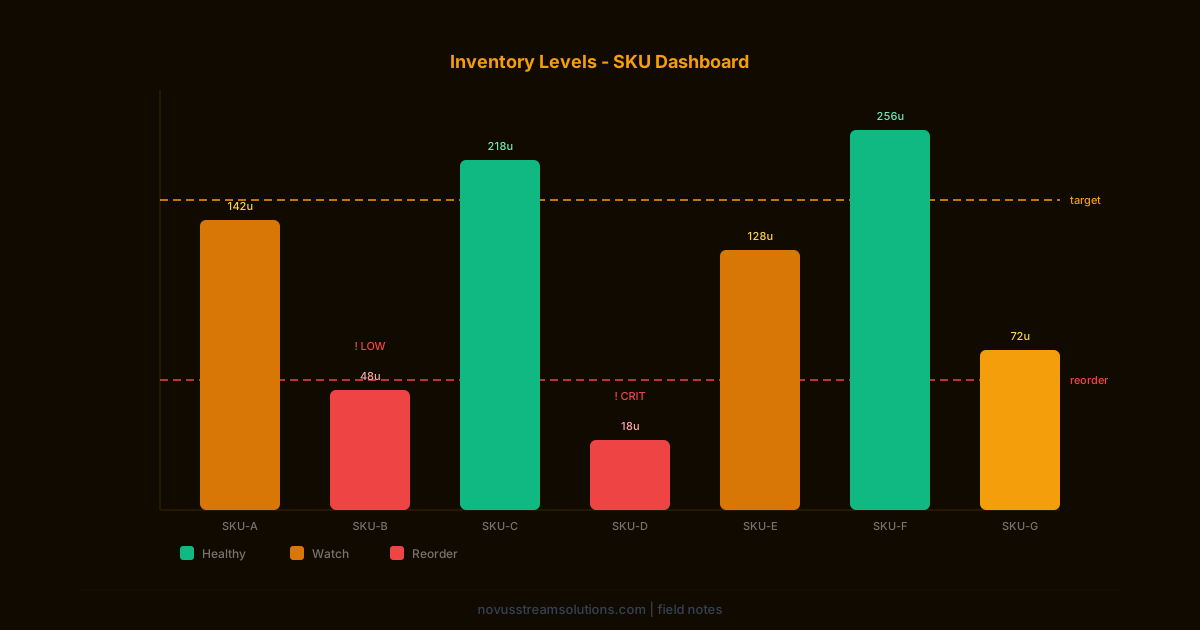
Small retail inventory failures fall into two categories: stockouts that lose sales and damage trust, and overstock that ties up cash and creates pressure to discount. Both failures are more predictable than they feel in the moment.
The goal of inventory planning at small scale is not accuracy—it is margin. A system that keeps you within 20% of optimal with minimal time investment beats a system that promises 5% accuracy but requires full-time attention.
Building your demand signal stack
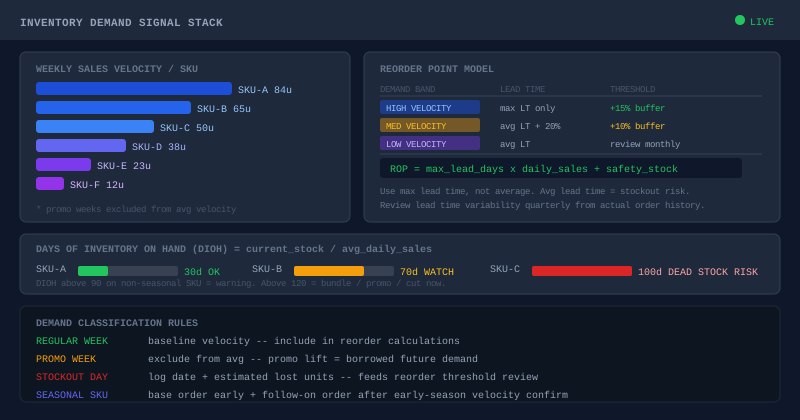
Before you can plan reorders, you need a consistent picture of demand. For most small retail operations, this means weekly sales velocity by SKU, return rates by product category, and a running log of stockout events (dates, durations, and estimated lost units).
Do not average demand across all weeks. Separate regular weeks from promotional weeks. Promotion lift is not demand—it is borrowed demand that you will pay back as a post-promotion dip.
- Set reorder points based on max lead time, not average lead time.
- Keep a 10–15% buffer above your calculated minimum for fast-moving SKUs.
- Review slow-moving SKUs monthly—dead stock accumulates quietly.
The one metric that prevents most dead stock
Days of inventory on hand (DIOH) is the simplest and most useful metric for small retail: current stock divided by average daily sales. A DIOH above 90 on a non-seasonal item is a warning. Above 120, you have a problem worth acting on now rather than later.
When DIOH climbs on a SKU, the options are bundling with a faster-moving product, a time-limited promotion with a clear end date, or a quiet price reduction. Do not wait for it to resolve itself—dead stock does not self-correct.
Supplier relationships and lead time variability
Inventory planning models break down when lead times are unpredictable. If your supplier quotes four weeks but delivers anywhere from two to seven, your reorder point calculation needs to use the worst case, not the average. This costs more in working capital but prevents the far more expensive outcome of a stockout during peak demand. Once you have twelve months of order history with a supplier, recalculate lead time variability quarterly rather than using the original estimate.
Supplier relationship quality directly affects inventory efficiency. Suppliers who communicate proactively about delays allow you to react faster — either pulling in orders from a secondary source or adjusting customer-facing availability windows before complaints arrive. Treat supplier communication as an operational input, not just a logistics formality. The five-minute call to confirm your order is in production before it is due pays for itself the first time it prevents a surprise.
Seasonal planning without overcommitting
Seasonal demand requires earlier inventory commitments than everyday operations, which creates tension with the cash-conservation goal. The practical solution for small retail is a base-plus-buffer model: order your conservative base level three to four weeks before the season, then place a smaller follow-on order once early-season sales velocity confirms whether you need the buffer. This approach trades some margin on the rush order for lower stockout risk without committing the full inventory investment upfront on an assumption.
For products with long lead times that cannot support a follow-on order, build your seasonal forecast from actual prior-year velocity rather than industry benchmarks. If you are in your first year with a seasonal SKU, start conservative and plan to leave some demand unmet rather than risking a large dead-stock position. Selling out early is a solvable problem you can capitalize on with a waitlist or a lead capture for next season. Large dead-stock positions are an expensive lesson that compounds into discount pressure and margin erosion.
Managing returns and reverse inventory flow
Returns are not just a customer service issue — they are an inventory planning variable. High return rates on specific SKUs signal either a product quality issue or a product description mismatch, both of which affect your forward inventory decisions. If a SKU consistently returns at 15% when your category average is 4%, investigate before reordering at the same volume. The cause may be something fixable in the product listing or packaging; it may also be a product that cannot be improved enough to hold its return rate. That distinction determines whether the SKU deserves continued investment.
Process returns promptly and track their condition. Returned inventory that is resalable should re-enter your available stock within your stated policy window so it can contribute to fill rates. Returned inventory that is not resalable should be categorized and written off quickly rather than carried on your books at full cost. Clean return accounting keeps your inventory records accurate, which keeps your reorder calculations trustworthy.
Building supplier redundancy before you need it
A single-supplier model is an inventory risk that compounds when that supplier has a problem. Manufacturing delays, quality issues, capacity constraints, or unexpected closure can leave you with unfillable orders and no alternative. For any SKU that represents more than 10% of your revenue, identify a backup supplier and place at least one qualifying order annually to keep the relationship active. The qualifying order may cost slightly more per unit than your primary supplier, but the insurance value is real.
Supplier diversification also gives you negotiating leverage. Suppliers who know you have an alternative are more likely to prioritize your orders and more likely to be transparent about capacity constraints before they become your problem. This is not adversarial — it is a normal commercial relationship with appropriate risk management built in. Most good suppliers understand this and respect buyers who operate with it, because it signals long-term reliability rather than transactional opportunism.
Inventory is fundamentally a cash-flow decision
The deepest way to understand inventory management is that every unit of stock is cash converted into a product, sitting on a shelf, unavailable for anything else until it sells. This reframes inventory from a logistics problem into a cash-flow problem: holding too much inventory is not just a storage cost but a tie-up of working capital that could be funding other parts of the business, and a stockout is not just a lost sale but a failure to convert available demand into the cash the business runs on. The goal of inventory planning is to hold exactly enough stock to capture demand without tying up more cash than necessary, which is a balance between two opposing cash risks.
Seeing inventory as cash changes the decisions you make. Dead stock is not just clutter; it is cash frozen in a product that may never sell, which is why it creates pressure to discount — recovering some cash is better than leaving it all frozen. Overordering to feel safe is spending cash to buy insurance against stockouts, and that insurance has a real price in the working capital it consumes. The cash-flow lens makes the tradeoffs concrete: every inventory decision is a decision about where to put the business's limited cash, and the right level of stock is the one that captures demand efficiently without immobilizing more cash than the stockout risk justifies. For a small operation where cash is the binding constraint, this framing is not academic — it is the difference between inventory that funds the business and inventory that starves it.
Not all SKUs deserve equal attention
A common inefficiency in small-retail inventory is treating every SKU with the same level of attention, when in reality a small number of products usually drive most of the revenue and deserve correspondingly more careful planning. The principle is to classify your catalog by contribution — the high-volume, high-revenue SKUs that are the core of the business, the moderate ones, and the long tail of slow movers — and to focus your forecasting and reorder discipline where it matters most. The top SKUs justify careful demand tracking, tight reorder points, and supplier redundancy; the long tail can be managed with simpler rules and reviewed less often, because the cost of getting them slightly wrong is small.
This prioritization is what makes inventory management sustainable for a small operation with limited time. Spending equal effort on a SKU that drives half your revenue and one that sells a few units a month is a misallocation of the scarce attention available; concentrating the careful work on the products that move the business and applying lighter-weight rules to the rest gets most of the benefit for a fraction of the effort. The slow movers still need monitoring — they are where dead stock accumulates — but they need monitoring for the specific problem of aging, not the detailed velocity forecasting the top SKUs warrant. Matching the intensity of attention to the importance of the SKU is how a small operator keeps inventory under control without it consuming all their time.
Safety stock without tipping into overstock
Safety stock — the buffer you hold above expected demand to absorb variability — is essential protection against stockouts, but it is also exactly where overstock creeps in, so it has to be sized deliberately rather than padded out of anxiety. The right amount of safety stock depends on two things: how variable your demand is for that SKU, and how variable and long your supplier lead time is. A SKU with steady demand and a reliable, fast supplier needs little buffer; a SKU with spiky demand and an unpredictable supplier needs more. Sizing safety stock to these actual variabilities, rather than applying a flat buffer to everything, keeps you protected where the risk is real without holding excess where it is not.
The discipline is to resist the temptation to inflate safety stock as a general hedge against worry, because that anxiety-driven padding is how a reasonable buffer becomes overstock that ties up cash. Each unit of safety stock is protection against a specific risk — demand spiking, lead time slipping — and should be justified by that risk rather than by a vague desire to never run out. The cost of a stockout is real, but so is the cost of carrying excess, and good safety-stock sizing weighs the two for each SKU rather than defaulting to "more is safer." Holding the right buffer on the right SKUs, sized to their actual variability, is the precise middle path between the stockout risk of too little and the cash-and-deadstock risk of too much.
Sell-through rate as the health signal
Sell-through rate — the percentage of received inventory that sells within a period — is one of the most informative single metrics for small-retail inventory health, because it directly measures whether you ordered the right amount. A high sell-through means your inventory is moving efficiently and you may even be leaving demand unmet; a low sell-through means you overordered relative to demand and are accumulating stock that will age. Tracking sell-through by SKU over time reveals which products are well-matched to demand and which are consistently overordered, which is exactly the signal you need to adjust future orders toward the right quantities.
The value of sell-through over a raw stock count is that it relates inventory to demand rather than measuring it in isolation. A high stock count is not inherently bad if the product is selling quickly, and a low stock count is not inherently good if it means frequent stockouts; sell-through captures the relationship between what you hold and what sells, which is the thing that actually matters. Using sell-through to guide reorder quantities — ordering more of what sells through quickly and less of what does not — is a feedback loop that progressively tunes your inventory to actual demand. It is a simple metric that, watched consistently, prevents both the slow accumulation of dead stock and the repeated stockouts that come from systematically misjudging demand, by giving you a clear, per-SKU signal of where your ordering is too aggressive or too cautious.
Markdown discipline for aging stock
When a SKU is not selling and its inventory is aging, the hardest discipline is acting decisively rather than waiting for it to resolve itself, because dead stock does not self-correct and the cost of holding it only grows. A markdown to move aging stock feels like admitting a mistake and accepting a loss, which is psychologically uncomfortable, but the alternative — holding the stock at full price indefinitely while it occupies cash and space — is usually the more expensive choice. The discipline is to set a threshold at which aging stock gets actively cleared, through a markdown, a bundle, or another mechanism, rather than letting it sit on the hope that demand will eventually appear.
The key to markdown discipline is to act early and decisively rather than late and repeatedly. A single clear markdown that moves the stock recovers cash and frees space and attention; a series of small, reluctant reductions drags out the process, trains customers to wait for deeper cuts, and often recovers less in total. Setting an aging threshold in advance — a number of days of inventory on hand above which a slow-moving SKU triggers a clearance decision — removes the in-the-moment reluctance and makes the markdown a process rather than a painful one-off judgment. The goal is to recover the cash frozen in dead stock and redeploy it, accepting the loss cleanly rather than letting the position deteriorate while you avoid acknowledging it. Decisive markdown discipline is how you stop dead stock from compounding into a larger cash and margin problem.
Inventory data as a demand-forecasting loop
The inventory decisions you make and the outcomes they produce are themselves the best source of demand-forecasting data, if you capture them systematically. Every order, every sell-through rate, every stockout, and every markdown is information about how your demand estimate compared to reality, and feeding those outcomes back into your next forecast is what makes the forecast progressively more accurate. A small operation that records not just what it ordered but how that order played out — sold out early, aged into a markdown, matched demand well — builds, over a few cycles, a far better demand model than any external benchmark could provide, because it is built from its own actual results.
This feedback loop is especially valuable for seasonal and variable products, where external benchmarks are least reliable and your own prior-year actuals are most predictive. The discipline is to treat each inventory cycle as a forecasting experiment whose result is recorded, so that the next cycle starts from evidence rather than from a fresh guess. Over time, this turns inventory planning from a perpetual estimation problem into a progressively-tuned system informed by your accumulating history. The operator who closes the loop — ordering, observing, recording, and adjusting — gets steadily better at matching inventory to demand, while the operator who treats each order as an independent guess never accumulates the learning that would improve the next one. Inventory is a feedback system, and capturing the feedback is what compounds into accuracy.
How a lean store approaches this in practice
A small physical-goods operation run under this philosophy treats the goal of inventory planning at small scale as margin and cash efficiency, not theoretical accuracy. The practical approach favors conservative base orders with the option of a follow-on order once early velocity confirms demand, demand signals read from actual sell-through rather than industry benchmarks, and a disciplined approach to clearing aging stock before it becomes a drag. The operating principle is the same one that governs a lean software operation — keep the operation lean and the cash efficient — applied to physical inventory, where the cost of overcommitting is even more concrete because it is cash frozen in stock.
The common thread is the discipline of not overcommitting resources on an unproven assumption. Just as a lean software operation scopes products narrowly and kills what does not earn its place, a lean store orders conservatively and clears what does not sell, because both are expressions of an operation that treats cash and attention as scarce and allocates them on evidence. Inventory planning for a small retail operation is, at bottom, the same keep-it-lean discipline that runs through everything: hold what demand justifies, clear what it does not, and let the actual results rather than optimistic assumptions drive the next decision. The forecasting and reorder practices in this post are how that discipline becomes concrete in the warehouse, the same way the build-ship-measure loop makes it concrete in the codebase.
Frequently asked questions
Quick answers to common questions about this topic.
How do small retailers plan inventory without a data team?
Use simple signals — past sales, seasonality, and lead times — to build modest forecasts with explicit uncertainty, then reorder against a buffer. You do not need sophisticated tools, just consistent attention to the few drivers that matter.
How do I avoid stockouts and overstock?
Track sell-through and lead time, hold a sensible safety buffer, and reorder before you hit zero rather than after. Forecasting with uncertainty bands beats single-point optimism that leaves you short or overstocked.