2026 · Field notesAbout 13 min readNovus Stream Solutions
Trust in the first 90 days: what actually matters when your audience is brand new
What new audiences actually use to decide whether you are worth following—delivery consistency, expectation clarity, and the three things that break trust faster than anything else.
Contents
- 1.Overview
- 2.The first impression window: days one through thirty
- 3.The three trust-breakers
- 4.Days 31 to 90: converting early trust into lasting relationship
- 5.What 90-day trust actually enables
- 6.The onboarding experience as a trust signal
- 7.What to do when you break trust early
- 8.Trust is built in deposits, not gestures
- 9.Consistency beats intensity
- 10.The subscription is a promise you signed
- 11.Transparency turns mistakes into trust
- 12.Why owned channels build trust faster
- 13.Measuring trust before it shows in revenue
- 14.Trust is the precondition for every ask
Overview
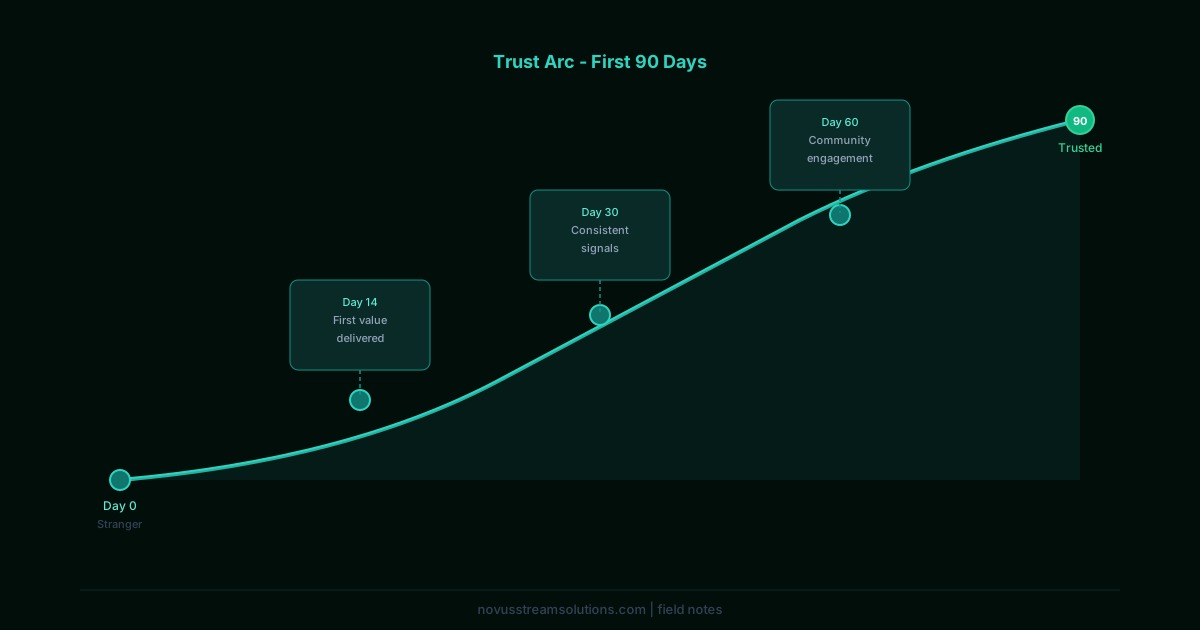
New audiences do not trust you yet, which means every decision they make about your content is based on surface signals: did you show up when you said you would, does your content match what you promised when they subscribed, and do you seem like someone who will be here next month.
These signals are not glamorous but they compound faster than engagement tactics. An audience that trusts your consistency is one that recommends you to others unprompted.
The first impression window: days one through thirty
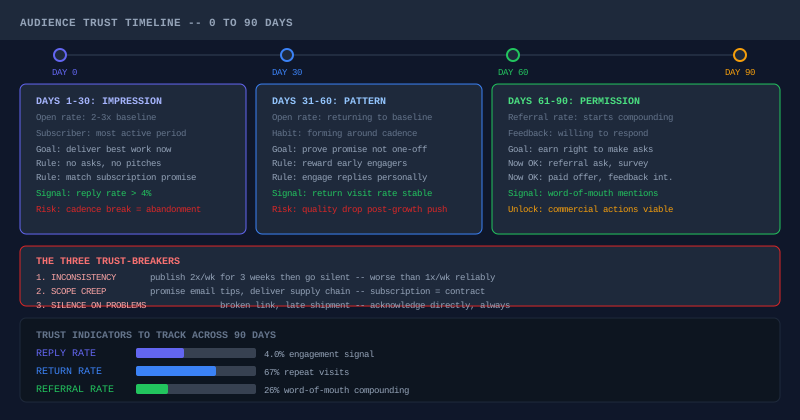
New subscribers are most active in the first seven days. Open rates on a welcome sequence run two to three times higher than your baseline newsletter open rate. Use this window to deliver your best work—the piece that best represents what being your subscriber feels like at its highest.
Do not use this window to ask for things. No referral requests, no product pitches, no surveys. Just deliver the value you promised.
The three trust-breakers
Inconsistency: publishing twice a week for three weeks and then going silent for two weeks is worse than publishing once a week reliably. Audiences form habits around your cadence. Breaking the cadence without explanation feels like abandonment.
Scope creep: if you promised email insights and you start sending supply chain tips, people feel misled even if both topics are genuinely useful. The subscription promise is a contract.
Silence on problems: when something goes wrong—a delayed shipment, an incorrect email, a broken link—acknowledging it directly and briefly is always better than hoping nobody notices. Audiences forgive mistakes they understand.
Days 31 to 90: converting early trust into lasting relationship
If the first 30 days are about keeping the promise, days 31 to 90 are about demonstrating that the promise was not a temporary effort to impress new subscribers. This is where most audience-building efforts plateau — the creator maintains quality during the acquisition push and then relaxes once the list is growing. The audience does not see an announcement of lower quality; they just gradually notice less value arriving per unit of their attention, and they quietly disengage.
Use this window to find and reward your early active members. If you have a community channel, notice who replies and engage back specifically. If you have an email list, notice who clicks and consider sending them something extra once — a resource, an early look, a direct question about what they find most useful. The goal is not to create a reward program; it is to demonstrate that engagement with your content gets noticed. That signal, experienced by even a small number of early members, diffuses through their behavior in ways that shape the culture of the broader audience.
What 90-day trust actually enables
The practical value of a trusted 90-day-old audience is that it gives you permission to make asks that a newer audience would reject. A request for a referral, a survey response, a product feedback interview, or a paid offer lands differently when the audience has seen your consistency for three months versus three weeks. Trust is not just a nice-to-have metric for content creators — it is the precondition for the commercial and growth actions that make the work financially sustainable.
Track your trust indicators across the 90-day window: reply rate on key emails, return visit rate, word-of-mouth referrals, and direct mentions in community conversations. These signals tell you whether you are building an audience or accumulating a list. The distinction matters because audience members behave differently from list entries — they recommend you, they participate in feedback, and they convert on offers at rates that make the economics of content creation work.
The onboarding experience as a trust signal
The first few interactions a new audience member has with your operation set a template for how they interpret everything that follows. A welcome sequence that delivers what it promised, arrives on time, and points to additional resources sends a signal about operational reliability. A welcome sequence that is generic, poorly timed, or references things you told them they would receive but did not sets a different kind of template — one that creates skepticism before you have had a chance to build credibility.
Audit your onboarding flow from the perspective of someone who just joined and knows nothing about you. Read the welcome email without the context you carry as the author. Does it explain clearly what to expect? Does it make the next step obvious? Does it deliver specific value, or does it primarily serve your needs by asking for referrals and product feedback before you have demonstrated worth? The first ten days of the subscriber experience are the most leverage-rich point in the trust-building arc — invest in them accordingly.
What to do when you break trust early
Trust breaks happen even in well-run operations: a technical error sends the wrong email, a product promise is not delivered on time, or a communication goes out with incorrect information. How you respond to an early trust break matters as much as whether it happens. Acknowledgment that is prompt, specific, and focused on what you are doing to fix it rather than on defending why it happened recovers more trust than the incident costs — if you act quickly and without defensiveness.
The most common mistake in trust recovery is over-explaining. A brief acknowledgment and a concrete correction is more trust-building than a long explanation of what went wrong internally. Your audience does not need to understand the operational details of your mistake; they need to see that you are reliable enough to catch your own errors and correct them. A short "this went wrong, here is what we did to fix it, and here is the correction" email recovers more goodwill than an elaborate apology that reads like a press release.
Trust is built in deposits, not gestures
The most useful mental model for building trust with a new audience is that trust accumulates like a balance, through many small deposits over time, rather than being won in a single grand gesture. Each time you show up when you said you would, deliver what you promised, and behave as the audience expected, you make a small deposit; each time you fall short, you make a withdrawal. The balance is what determines whether the audience trusts you, and it is built up gradually through consistency rather than established at once through any single impressive act. This is why trust-building is slow and unglamorous: it is the accumulation of reliable small actions, not a moment of brilliance.
Understanding trust as accumulated deposits reframes what to focus on. The instinct of a new operation is often to make a big impression — a flashy launch, an ambitious promise — but a single big gesture does little for a trust balance that is built from consistency, and an ambitious promise not kept is a large withdrawal. The audience is watching for the pattern of small reliabilities far more than for any one peak, because the pattern is what predicts future behavior, which is what trust really is: a prediction that you will continue to behave well. Focusing on making many small, reliable deposits — consistent delivery, kept promises, met expectations — builds the balance more durably than chasing a single trust-winning event, because trust is a sum of behavior over time, not a prize awarded for one performance.
Consistency beats intensity
A specific and counterintuitive lesson about new audiences is that consistency matters more than intensity — that publishing reliably at a sustainable cadence builds more trust than publishing intensely and then erratically. An audience forms a habit around your cadence, an expectation of when and how often they will hear from you, and that expectation becomes part of the trust relationship. Meeting it consistently, even at a modest level, is a repeated deposit; breaking it, even after a period of intense output, reads as instability and abandonment. The audience that sees you publish reliably once a week trusts you more than the audience that saw you publish daily for a month and then go quiet.
This means the sustainable cadence is the right one, not the maximal one, because trust depends on the cadence being maintainable. A new operation that overcommits to an intense schedule it cannot sustain sets itself up for the exact trust-breaking inconsistency that the intensity was meant to avoid. The discipline is to choose a cadence you can hold reliably for the long term and then hold it, rather than to impress early with a pace that will inevitably slip. Consistency at a sustainable level compounds into trust; intensity that collapses into inconsistency undermines it. The audience is not keeping score of your peak output; it is keeping score of your reliability, and reliability is a function of consistency over time, which only a sustainable cadence provides.
The subscription is a promise you signed
When someone subscribes to your content or audience, they are agreeing to a specific implied contract: they expect a particular kind of value, on a particular cadence, about particular topics, based on what you presented when they signed up. Honoring that contract — delivering the value they expected, on the topics they expected — is a continuous trust deposit, and violating it, even with content that is genuinely good, is a trust withdrawal because it breaks the agreement they made. The subscriber who signed up for one kind of value and receives another feels misled, not delighted, even if the new value is real, because the issue is the broken expectation rather than the quality of what arrived.
This is why scope discipline matters so much for a new audience specifically. The temptation to broaden into adjacent topics, to share everything interesting, feels like generosity but reads as scope creep that violates the subscription promise. The audience subscribed to a specific thing, and delivering that specific thing reliably is what builds trust; drifting into other topics, however good, erodes the clarity of the contract and the trust that depends on it. Honoring the implied subscription agreement — staying on the value and the topics the audience signed up for — is one of the clearest forms of consistency, and it is especially important early, before the audience has the accumulated trust to follow you into new territory. The contract is what they agreed to; keeping it is how you earn the right to eventually expand it.
Transparency turns mistakes into trust
Counterintuitively, how you handle mistakes can build more trust than never making them visible, because transparency under pressure is exactly the signal a new audience uses to judge whether you are trustworthy. When something goes wrong and you acknowledge it promptly, specifically, and without defensiveness, the audience sees an operation that is honest and reliable enough to own its errors — which is more reassuring than an unbroken but unproven facade of perfection. A mistake handled with transparency demonstrates the character the audience is trying to assess, and that demonstration can deposit more trust than the mistake withdrew.
The mechanism is that trust is fundamentally a prediction about future behavior, and seeing how you behave when things go wrong is far more informative than seeing how you behave when everything is smooth. Anyone can look good when nothing is broken; the audience learns who you really are when you face a problem, and an honest, prompt, non-defensive response under that pressure is powerful evidence of trustworthiness. This is why hiding mistakes is the wrong instinct: it forfeits the opportunity to demonstrate the exact quality the audience is looking for, and it risks the far larger trust break of being caught concealing rather than disclosing. Transparency about problems is not damage control; it is one of the most effective trust-building tools available, because it provides the audience the evidence of character that smooth operation never can.
Why owned channels build trust faster
The channel where you build a relationship with a new audience affects how fast trust accumulates, and owned channels — email especially — build trust faster than rented ones like social platforms. On an owned channel, the audience has explicitly invited you into a direct space, and the interaction is not mediated by an algorithm that decides what they see, so your consistency is fully visible to them: when you send the weekly email, they get it, and the reliability deposit lands directly. On a rented channel, your content competes with an algorithm and a feed, so even reliable output may not consistently reach the audience, which makes the consistency that builds trust harder to demonstrate.
The directness of an owned channel also raises the stakes in a way that builds trust. Someone giving you their email address has extended more trust than someone clicking follow, and meeting that higher trust with reliable, valuable delivery deposits more in return. The relationship is more personal, the delivery is more certain, and the consistency is more visible, all of which accelerate the accumulation of trust compared to a rented channel where the relationship is shallower and the delivery less certain. This is why a hub-and-spoke approach that centers an owned channel is not just a distribution strategy but a trust strategy: the owned channel is where trust is built fastest, because it is where your reliability is most directly experienced by an audience that has most directly chosen to receive it.
Measuring trust before it shows in revenue
Trust is a leading indicator of the commercial outcomes a content operation eventually needs, which means it can and should be measured before it shows up as revenue. The signals of accumulating trust — reply rates on your emails, return-visit rates, unprompted word-of-mouth referrals, and direct mentions in community conversations — move before the revenue does, because trust is the precondition that later enables the commercial asks. An operation that tracks these trust indicators across the early window can tell whether it is building a genuine audience or merely accumulating a list of names, well before the difference shows up in whether offers convert.
The distinction these signals reveal — audience versus list — is the one that matters most for the eventual economics. A list is a set of names that may or may not care; an audience is a group that trusts you, recommends you, participates in feedback, and converts on offers at rates that make the work sustainable. The trust indicators are how you tell which you are building before you test it commercially. An operation that watches reply rates and referrals climb knows it is building real trust even while revenue is still small; one that sees a growing list with flat engagement knows it has names without trust, which is a warning the headline subscriber count would hide. Measuring trust through its leading signals lets you correct course early, while the audience is still forming, rather than discovering the absence of trust only when an offer fails to convert.
Trust is the precondition for every ask
The ultimate reason to invest in trust during the early window is that trust is the precondition for every commercial and growth action that makes the work sustainable. A referral request, a survey, a feedback interview, a paid offer — each of these asks the audience to do something for you, and each lands in proportion to the trust you have accumulated. An audience that trusts you after months of consistency responds to these asks; an audience that does not trust you yet rejects them, often resenting the ask itself as premature. Trust is the asset that the asks draw down, and building it first is what makes the asks viable later.
This is why the early window should be protected from premature asks, and why trust-building is not a soft nicety but the hard foundation of the business model. Asking too early — pitching a product or requesting a referral before trust is established — not only fails but actively damages the trust that was forming, because it signals that the relationship is about extraction rather than value. The discipline is to build trust through consistent value delivery before making any significant ask, and to recognize that the patience this requires is an investment in the asset that all future asks depend on. Trust is what makes a content operation financially viable, and treating it as the precondition it is — building it deliberately before drawing on it — is the difference between an audience that sustains the work and a list that resents being sold to.
Frequently asked questions
Quick answers to common questions about this topic.
How do you earn trust with a brand-new audience?
By being consistent and transparent and delivering on small promises before asking for anything big. Early trust comes from showing up reliably and being honest, not from claims you cannot yet back up.
What matters most in the first 90 days?
Proof over promises — a real product, real responsiveness, and a clear, honest story. A new audience has no history with you, so every small kept promise is a deposit in the trust account.